artemis logo

Charges and costs

The charges and costs you pay in relation to investing in funds can have a real impact on the returns that you get, so it is important you know what you will pay.

This page explains the charges and costs applicable to the following Artemis fund ranges:

  • Artemis UK-domiciled unit trust funds
  • Artemis UK-domiciled Open-Ended Investment Company sub-funds
  • Artemis UK-domiciled Non-UCITS Retail Scheme funds
  • Artemis Luxembourg-domiciled SICAV sub-funds


Different costs and charges apply to investment trusts. Shareholders in investment trusts managed by Artemis should refer to the information on fees on the relevant fund pages. 

Summary of charges and costs

There are several types of charges and costs. Each type of charge and cost in the table below is explained in more detail later in the page.

One-off charges

TypeExplanationIs this charge applied?
Initial chargeApplied when you invest in a fundNo
Exit chargeApplied when you leave a fundNo
Dilution adjustmentAn adjustment to the fund price that may apply when investors buy or sell units. Its purpose is to protect existing investors from the transaction costs created by other investors entering or leaving the fund. Yes (only applied in certain circumstances)

Ongoing charges

TypeExplanationIs this charge applied?
Annual management chargePaid to Artemis for managing the fundYes
Administration feeCovers the costs of operating the fund (excluding performance fees or transaction costs)Yes
Subscription taxPaid to the Luxembourg regulatorYes (Luxembourg SICAV funds only)

Performance fees and transaction costs

TypeExplanationIs this charge applied?
Performance feePaid to Artemis when a fund exceeds its stated performance target.Yes (only for certain funds)
Transaction costsCosts incurred by a fund when buying and selling the fund's underlying investments, such as broker commissions and taxes.Yes

One-off charges

Sometimes called the ‘entry charge’, this is an upfront charge paid when you invest in a fund and is deducted from your investment before you invest. This covers the costs of setting up your investment, such as administration and marketing costs.

Artemis does not apply an initial charge to any of its funds.

This is a fee charged before the proceeds of your investment are paid out.

Artemis does not apply an exit charge to any of its funds.

A dilution adjustment is not a charge but it may affect the amount of money you invest, or the proceeds you receive when you exit a fund.

Artemis operates a single pricing methodology for its funds. This means on any dealing day, each share/unit class of a fund has only one price at which deals are made.

To determine the price of a fund (and the underlying share/unit classes), the administrator refers to the mid-market value of the underlying investments. The mid-market value is the price between the quoted bid (sell) and offer (buy) prices available in the market. The overall difference between the lower bid price and the higher offer price is known as the ‘bid / offer spread’.

A dilution adjustment is something that can happen on any dealing day - the pricing basis of a fund is changed from mid-market pricing to towards either the lower ('bid') or higher ('offer') pricing. The amount of a dilution adjustment, either up or down, is calculated by reference to the estimated costs of dealing in the underlying investments, including any dealing spreads, broker commissions and taxes.

This adjustment mechanism is used only to protect investors from the cost of investments being bought and sold as a result of other investors joining or leaving the fund. The costs associated with this can reduce – or dilute – the value of the fund for existing investors. The adjustment is triggered only when significant net inflows or net outflows take place. ‘Net inflows’ means the total value of subscriptions into the fund exceeds the total value of redemptions, i.e. there are more buyers than sellers. ‘Net outflows’ means the opposite, where the total value of redemptions exceeds the total value of subscriptions. ‘Significant’ typically means large, as a percentage of the fund’s value, and in excess of a pre-defined threshold.

For net inflows above the threshold, the price is adjusted above the mid-market value, reflecting the costs of purchasing underlying investments. For net outflows above the threshold, the price is adjusted below the mid-market value, reflecting the costs of selling underlying investments. This is illustrated in the following table:

ScenarioNormalLarge net inflowsLarge net outflows
Activity required by the fundMinimal buying or selling of investmentsNeed to purchase investmentsNeed to sell investment to raise cash
Dilution adjustment triggeredNoYes, if net inflows are greater than the thresholdYes, if net outflows are greater than the threshold
Direction of adjustmentN/A (mid-market pricing)Price needs to adjust upwardsPrice needs to adjust downwards
Example price per unit/share*£1.0000£1.0047£0.9991

* Illustrative only – the actual adjustment amount will depend on the type of investments held by the fund.

Please refer to a fund’s prospectus for the typical range of dilution adjustments for each fund.

Ongoing charges

Ongoing charges represent the annual costs of operating the fund and are deducted directly from its assets. They therefore affect the price of each unit or share.

Different charging bases apply to different types of funds. These are detailed below.

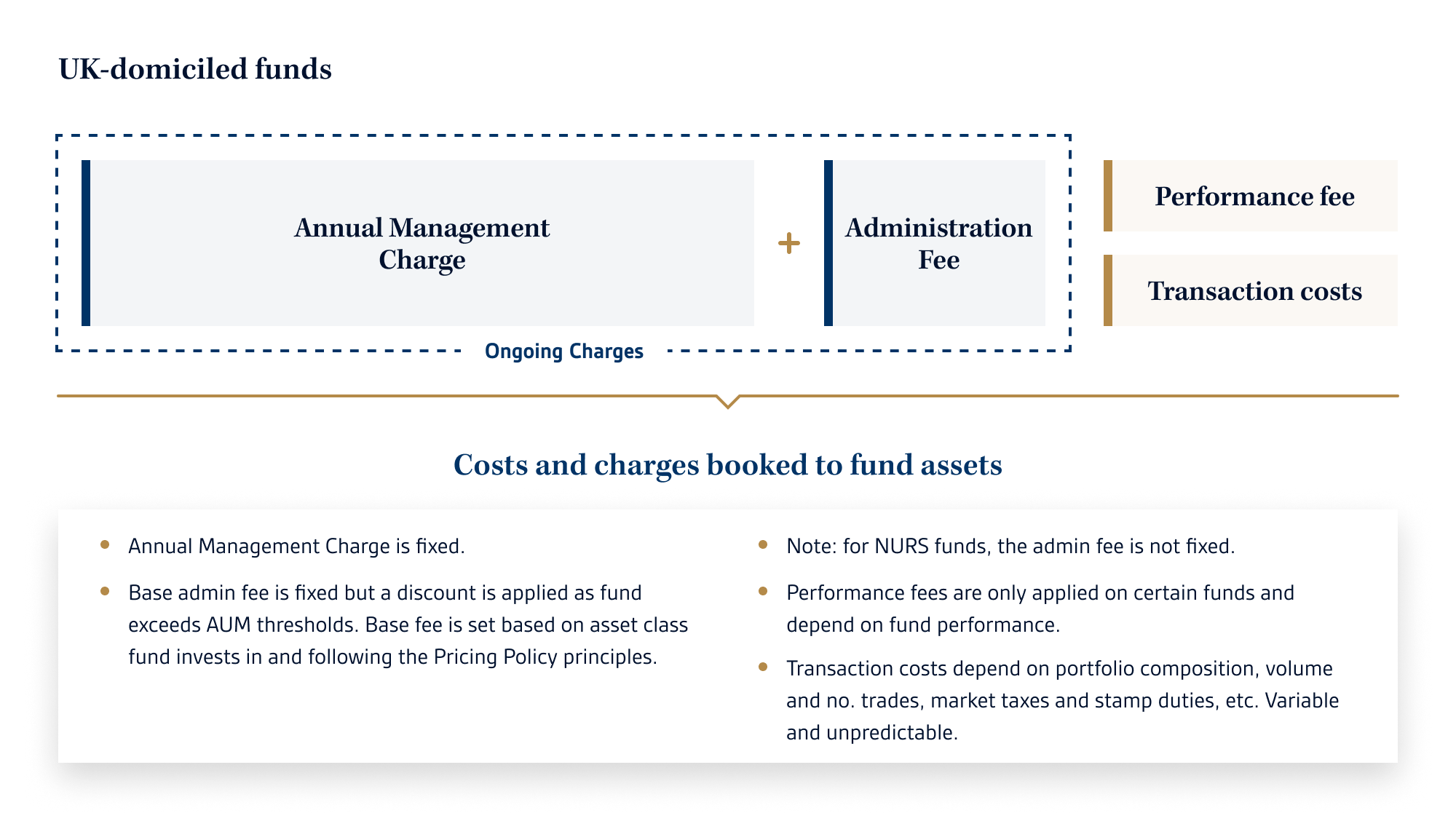
Ongoing charges are calculated by adding together:

  1. the Annual Management Charge, which is paid to Artemis for managing each fund. It is a fixed percentage which is set depending on the fund and class in which you invest. The fee is calculated daily, based on the value of the fund’s net assets and is reflected in the daily value of the fund’s assets. Different charges are applied for different classes of units/shares.
  2. an Administration Fee, which covers other costs incurred in operating each fund, such as fees paid to the independent trustee of the funds, to the funds’ administrator, and to other service providers such as custodians, lawyers and accountants. It excludes transaction costs or performance fees (see ‘Performance fees’ below).

Annual Management Charge + Administration Fee = Ongoing Charges

While the annual management charge component is a fixed percentage, the administration fee can change, meaning that the ongoing charges are variable.

The administration fee is paid to Artemis, who use it to pay the costs the fund incurs.

The administration fee is calculated by:

  • taking each fund’s base administration fee, as set out in the fund’s prospectus; and then
  • applying a discount based on the size of the fund, as set out in the table below.

The base administration fee for each fund, and the minimum fee which can apply after the discount, is set according to each fund’s overall investment strategy and the type of instruments the fund invests in. For example, funds which focus on investing in markets other than the UK, or which have a more specialist investment objective, usually incur higher costs.

Fund's net asset value (NAV)Discount to be applied to the base administration fee to arrive at the administration fee
Up to £250mNo discount applied
Between £250m and £750m0.01%
Between £750m and £1.5 billion0.03%
Between £1.5 billion and £3 billion0.05%
Above £3 billionOnce a fund's NAV reaches this threshold, a minimum administration fee will apply rather than a discount. See the relevant fund's prospectus for further details.

Each fund’s net asset value is reviewed on the first business day of every calendar month.  The discount rate is then applied to the base administration fee until the next monthly review date.

If the administration fee paid to Artemis is not enough to cover all of the other ongoing costs of a fund, Artemis is responsible for any shortfall from its own resources.  On the other hand, if the administration fee paid to Artemis is higher than the actual amount of the other ongoing costs, Artemis retains any excess.  The fund size discount is intended to offset this, as costs tend to be proportionately lower for larger funds due to economies of scale.

Artemis reviews the fees and the fund size discount levels and thresholds at least annually to make sure that they remain appropriate. Artemis will not make any adjustments to the discounts or threshold levels described above without notifying existing investors in accordance with the UK Financial Conduct Authority’s rules.

For NURS funds there is a slightly different approach for the administration fees: there is no base administration fee, as there is for UK unit trusts and OEICs. Instead, the other administrative charges (such as fees paid to the independent trustee of the funds, to the funds’ administrator and to other service providers such as custodians, lawyers and accountants) are variable and do change from time to time. Therefore, the ongoing charge is variable, although the annual management charge component is a fixed percentage.

The Artemis Funds (Lux) range of funds are domiciled in Luxembourg and available to investors in the UK and certain European countries depending on the local registration of each fund and share class.

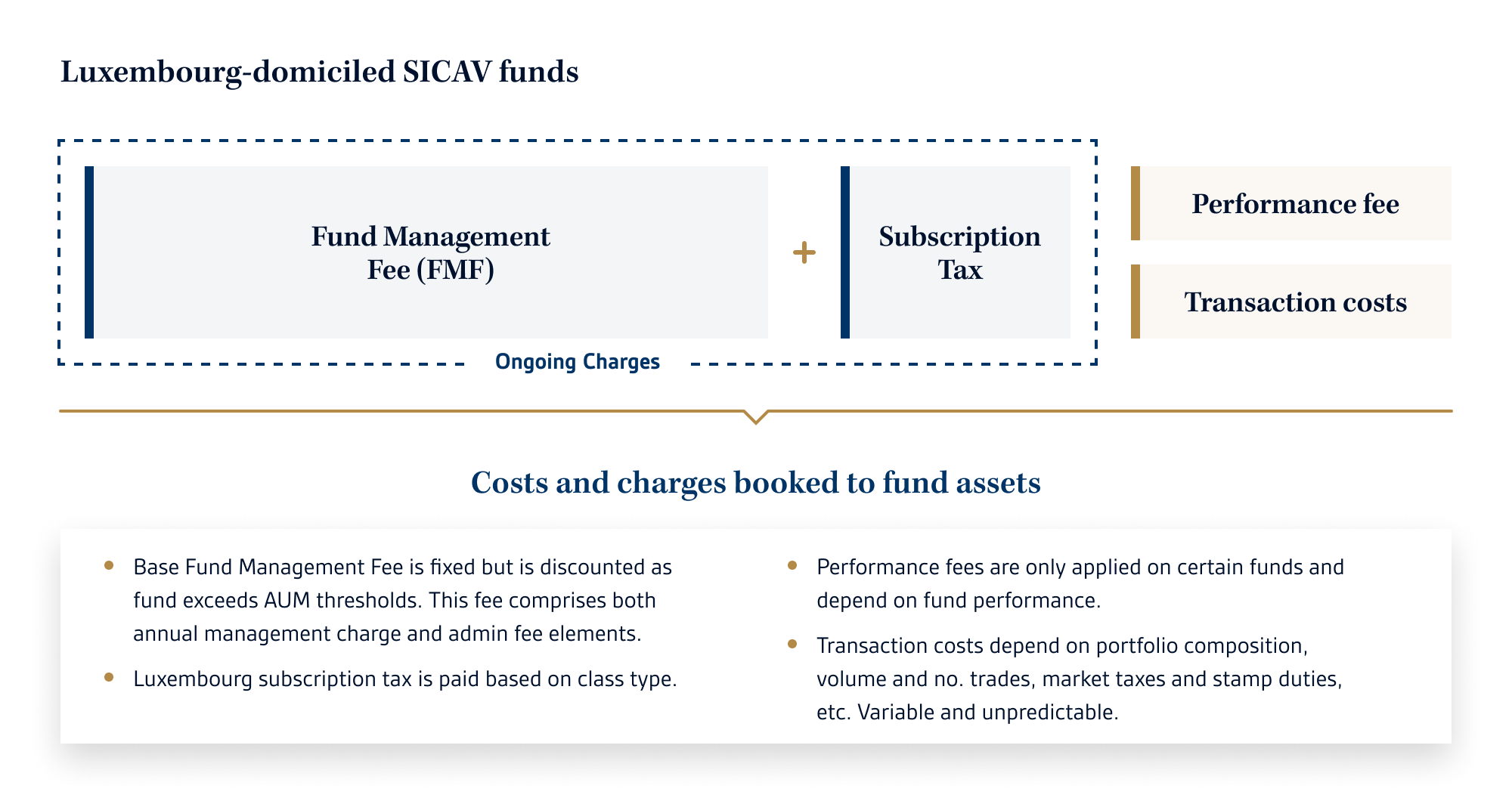
The components of the ongoing charges are slightly different to the UK-domiciled funds. Instead of adding together an annual management charge and the administration fee, the SICAV sub-funds have a Fund Management Fee (FMF) which covers both the annual management charge and the administration fee.

The ongoing charges for SICAV sub-funds are then calculated by adding together the FMF and a subscription tax.

Fund Management Fee + Subscription Tax = Ongoing Charges

The FMF is taken from the fund’s assets and paid to Artemis for managing each fund. It is similar in nature to a combined annual management charge and administration fee.  The FMF is a fixed percentage which is set depending on the fund and class. The FMF is accrued daily at each valuation point and paid on a monthly basis in arrears. Different charges are applied to different classes of shares.

If the FMF is not enough to pay all of the ongoing costs of a fund, Artemis is responsible for meeting any shortfall from its own resources. On the other hand, if the FMF paid to Artemis is higher than the actual amount of the ongoing costs, Artemis retains any excess.

To pass on economies of scale, a discount will be applied to the base FMF (except for founder share classes) depending on the total net asset value of the relevant fund. See the table below for the discounts and thresholds.

Discount to be applied to the base Fund Management Fee to arrive at the Fund Management Fee

Fund's net asset value (NAV) in EURGeneral share classesFounder (F) share classes
Below 1,000,000,000No discount appliedNo discount applied
1,000,000,0000.01%No discount applied
2,000,000,0000.02%No discount applied
3,000,000,0000.03%No discount applied
4,000,000,0000.04%No discount applied
5,000,000,0000.05%No discount applied
6,000,000,0000.06%No discount applied

Where a fund’s net asset value is greater than a threshold set out above, the corresponding discount will be applied, on a daily basis, to the base FMF applicable to all general share classes of that fund. Note: founder share classes are only available to certain institutional and professional investors approved by Artemis and: a) who subscribe within a certain period of the launch date of a fund; b) who meet the minimum investment criteria, and c) who have a prior written agreement with Artemis.

The directors of Artemis Funds (Lux) will review the base FMF, the discount and the items which are included in and/or excluded from the Fund Management Fee, at least annually.

Following the review, the directors may decide to change: (i) the level of the base FMF applicable to each share class; (ii) the thresholds at which a particular level of discount will apply, and/or the level of discount applicable at a particular threshold; and/or (iii) the items which are included in and/or excluded from the FMF. Shareholders will be notified as required by law prior to any such change taking effect.

The Subscription Tax is taken from the fund’s assets and paid to the Luxembourg regulator. It is a fixed percentage which is determined by the share class invested in and by whether the investors in that share class are retail or institutional investors. The tax is calculated daily, based on the value of the fund’s net assets and is reflected in the daily value of the fund’s assets. Different charges are applied to different classes of shares. Please refer to the SICAV prospectus for more information on the level of subscription tax applied.

A diagram in Appendix I illustrates the different charging structures for the UK and Luxembourg-domiciled funds.

The ongoing charges for each class can be found in the relevant KIID or factsheet, available on the fund explorer or in the literature library.

Performance fees

A performance fee is a payment made to Artemis when a fund beats its stated performance target. A performance fee is usually dependent upon the manager achieving specified performance returns over a set period of time, so is only charged in certain circumstances.

Performance fees (if any) are additional to the ongoing charge.

Artemis charges a performance fee on certain funds. If applicable, details of the performance fee can be found in the relevant prospectus, KIID or factsheet, available on the fund explorer or in the literature library.

Transaction costs

Transactions costs are incurred when a fund buys and sells its underlying investments. Investors do not pay separate transaction costs; they are borne by the fund itself and are reflected in its unit or share price.

Transaction costs are additional to the ongoing charges.

Transaction costs generally include:

  • Commissions paid to brokers for executing trades in the market;
  • Transfer taxes and stamp duties levied by governments or exchanges on the purchase or sale of securities;
  • Dealing spreads – this is the difference between the prices at which the fund buys or sells the underlying investments. Some investments (such as bonds, money market instruments, derivatives, etc.) have no separately identifiable transaction costs; instead these costs form part of the dealing spread. Dealing spreads vary considerably depending on the investment being bought or sold, the transaction value and market sentiment.

Transaction costs cannot be accurately predicted.

Comparing transaction costs for a range of funds may give a false impression of the relative costs of investing in them for the following reasons:

  • Transaction costs vary depending on the country and market in which investments are purchased and sold.
  • Transaction costs vary depending on the types of investment in which a fund invests and the volume and frequency of trading.

Investment managers do not make a financial gain from transaction costs, so there is no incentive to trade more than needed.

Types of unit and share classes

As with most fund managers, Artemis offers different ‘classes’ of units or shares. Each class has different investment minimums and charges.

Generally, larger investments can benefit from lower charges. Only the ongoing charge varies by class; the other charges and costs are the same across every other class of the relevant fund.

Minimum investments apply to investors investing directly with Artemis. If you are investing via an investment platform or a financial adviser, you may be able to invest in the classes with the lowest ongoing charges.

The unit/share classes available to investors in Artemis’ funds vary by fund.

For investors in the Artemis UK-domiciled funds, the following classes are typically available:

TypeDescription
Class CThese have a low minimum investment (typically £1,000 if investing directly with Artemis) but a higher ongoing charge compared to Class I unit/shares.
Class IThese have a higher minimum investment (typically £250,000 if investing directly with Artemis) but a lower ongoing charge compared to Class C and Class R unit/shares.
Class RThese have the highest ongoing charge. This is a legacy class for investors with a servicing agent who receives ongoing renewal commissions. Class R units/shares have been largely superseded by Class C units/shares and are not open to new investors, outside of corporate investors operating outside of the UK. If you are an existing investor currently invested in class R units, you should consider contacting Artemis on 0800 092 2051 to explore if you may be able to switch your investments to a lower-charging class.

For investors in the Artemis Funds (Lux) range of funds, these share classes are available:

TypeDescription
Class AThese have a lower minimum investment when compared to Class B (typically 25,000 in the unit/share class currency if investing direct with Artemis).
Class BThese have a higher minimum investment when compared to Class A (typically 250,000 in the unit/share class currency if investing direct with Artemis) but a lower ongoing charge than Class A shares.

These classes are available for subscription only via certain distributors, intermediaries and/or other professional investors who have separate fee arrangements with their clients.

Further information

Further information can also be found in the relevant prospectus, Key Investor Information Document (KIID), Key Information Document (KID) or fund factsheet, available on the fund explorer or in the literature library.

Appendix I
UK-domiciled fundsLuxembourg-domiciled funds

This page is designed to provide you with information about the costs and charges of Artemis funds and products. It is not a marketing communication and should not be used to make investment decisions. You should always refer to the relevant fund prospectus and KIID/KID before making any final investment decisions.

Artemis does not provide investment advice on the advantages or suitability of its products and no information provided should be viewed in this way. Should you be unsure about the suitability of an investment, you should consult a suitably qualified professional adviser.

Issued by: Artemis Fund Managers Limited and Artemis Investment Management LLP which are authorised and regulated by the UK Financial Conduct Authority; in Germany, AI Management (Europe) GmbH; in Switzerland, Artemis Investment Services (Switzerland) GmbH.

Knowledge centre

Need some help or have a question? These pages contain guidance and information about investing with Artemis and how to manage your investments with us.
Find out more

Quick links